case study

keroHire

Clarity in hiring. Confidence in decisions

DomainB2B Hiring OS · Web Platform
ScopeConcept to Prototype (4–6 weeks)
RoleProduct Designer
StatusConcept inspired by a project I previously worked on.
keroHire – evidence-led hiring platform overview

keroHire evidence-led hiring platform

Background

Hiring platforms today are optimized for process, not for decision quality.

Most tools successfully move candidates across stages, but they fail to answer the core hiring question: Do we actually have enough reliable evidence to hire this person?

During my previous experience working on a hiring-adjacent system at Aptagrim, I observed a recurring pattern: recruiters relied heavily on fragmented signals like CVs, interviews, and gut feeling rather than structured proof.

As AI-generated applications and global hiring increased, this gap became even more critical.

The Challenge

Modern hiring faces three major structural problems:

  • ATS workflows create administrative movement, not better decisions
  • Interviews generate subjective opinions instead of comparable evidence
  • AI-assisted applications make authenticity harder to interpret
  • Cross-border hiring introduces language and context gaps
  • German hiring environments demand auditability, seriousness, and defensible documentation

The result: Decisions are made with scattered signals and weak justification.

My Objective

Design a next-generation hiring system that:

  • Replaces traditional psychometric scoring with evidence-based evaluation
  • Reduces bias without removing human judgment
  • Supports bilingual hiring (DE/EN)
  • Introduces structured decision intelligence across the pipeline
  • Feels premium and modern, not like a generic ATS dashboard

The Core Insight

Traditional psychometrics often fail in real hiring contexts. Personality scores are hard to translate into job performance, create false certainty, and are difficult to defend in serious hiring environments.

Instead of scoring personality, keroHire scores evidence.

The Solution: The Evidence-Led Fit Model

A completely new evaluation framework based on three structured evidence streams rather than psychometric traits.

1. Work Signals

Role-specific micro-simulations designed to mirror real job scenarios. Examples: priority trade-off situations, stakeholder conflict responses, decision-making under ambiguity, execution planning tasks.

Output: Decision patterns, reasoning quality, and consistency, not personality labels.

2. Communication Signals

Derived from interviews and written responses, always anchored to real examples. Evaluated dimensions: clarity of thought, logical structure, reasoning depth, consistency across interactions, decision explanation quality.

This transforms interviews from subjective conversations into structured evidence.

3. Reliability Signals

A trust layer that highlights evidence gaps instead of forcing premature conclusions. Includes: evidence coverage gaps, contradictions between signals, incomplete assessments, AI-assisted content likelihood bands (LOW / MED / HIGH) with disclaimers.

Output focus: "What should we verify next?" instead of "final verdict".
Process Methodology

Architectural efficiencythrough intelligent integration

How keroHire connects ATS workflow with decision intelligence across job setup, pipeline, and candidate evidence reports.

Intelligent integration across hiring stages

01

Evidence-Led Fit Model

Three structured evidence streams: Work Signals (role-based simulations), Communication Signals (interview + written reasoning), Reliability Signals (evidence gaps + trust indicators).

02

Product Architecture

Intelligent integration across hiring stages. Job Workspace (setup + pipeline) and Candidate Workspace (Evidence Report Hub) with Dashboard, Jobs, Applicants, Interviews, Reports.

03

Pipeline to Decision System

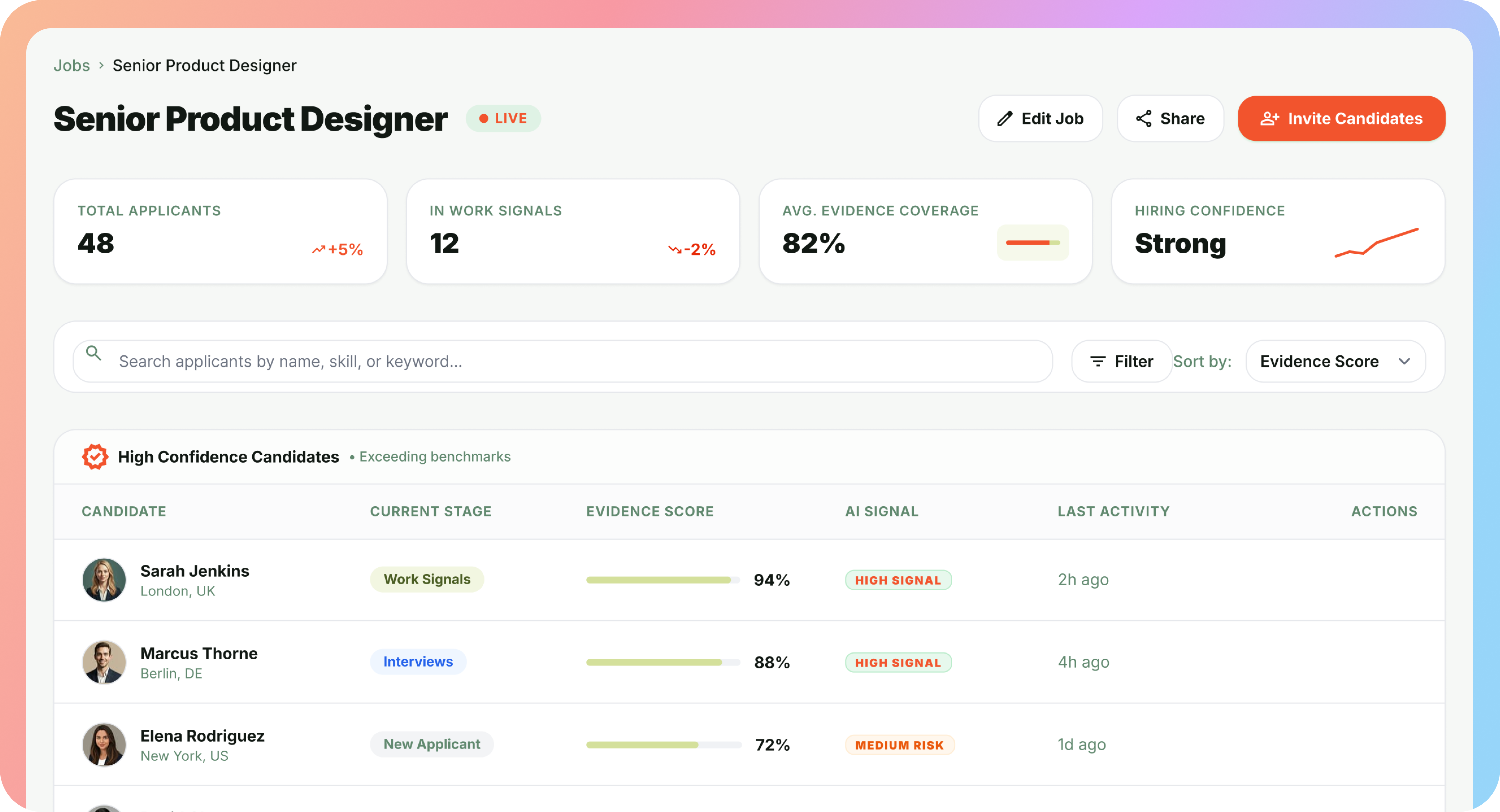
Applicant pipeline board shows evidence progress per candidate: screening score, evidence coverage, interview status, stage position, and action triggers.

04

Interview Intelligence

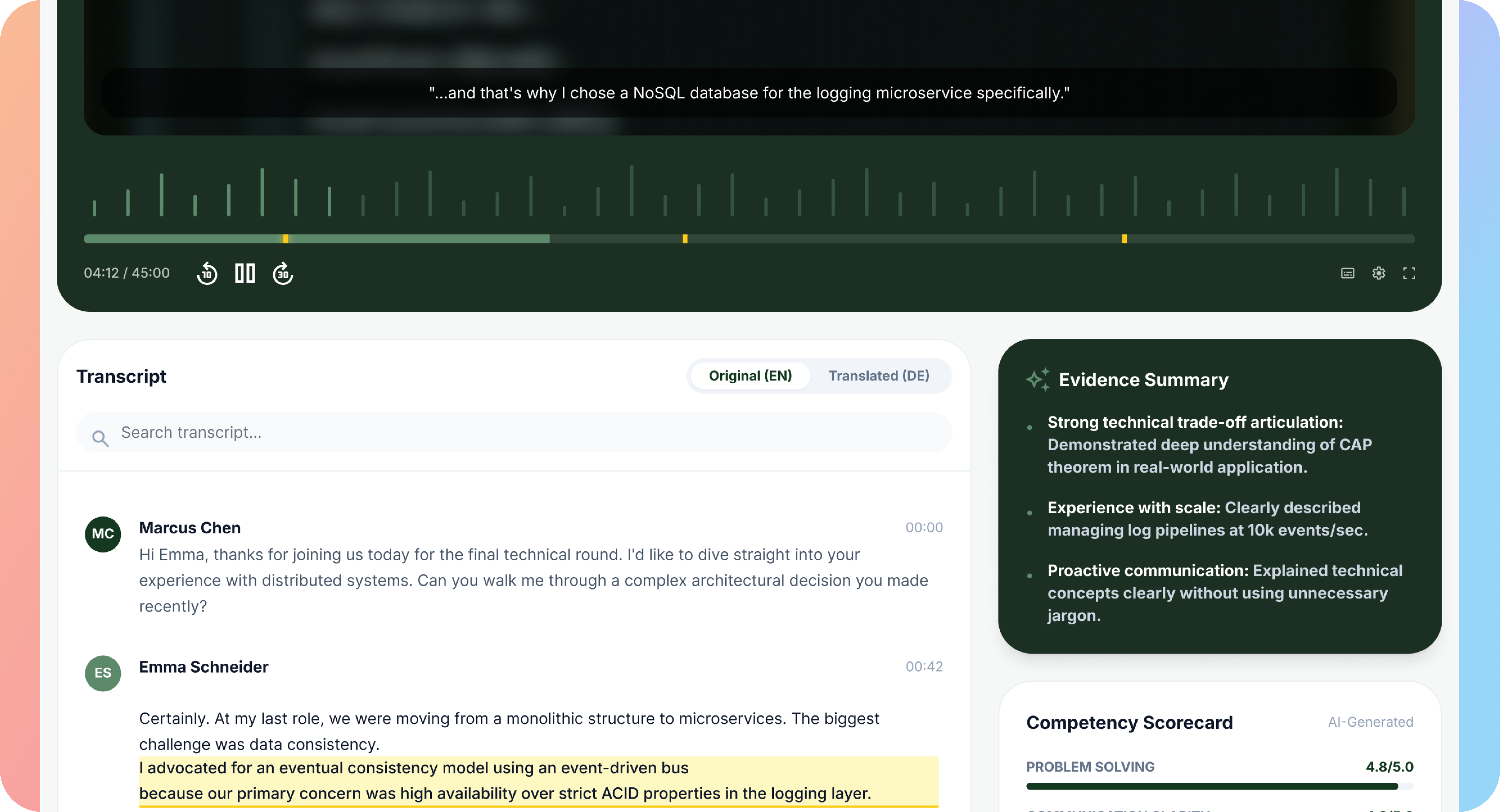
Transcribe, summarize, structure. Audio/video upload, automatic transcription, structured summaries, evidence quotes with timestamps, auto scorecards mapped to Evidence Map.

05

AI-Assisted Content Signals

Heuristic likelihood bands (LOW / MED / HIGH), transparent reasoning, explicit disclaimers, suggested follow-up actions. Ethical and defensible evaluation.

Decisions & Impact

Designing for evidence, not impressions.

Decision 01

Designing for evidence, not impressions

Why

Most hiring platforms rely on personality labels and abstract scores that are difficult to defend in real hiring discussions. The system needed to answer: What actual evidence supports this hiring decision?

Options explored

Keep psychometric dashboards · Add evidence tags to existing scores · Build parallel evidence layer · Replace psychometrics with evidence streams

Final solution

Completely moved away from traditional psychometric scoring. Created the Evidence-Led Fit Model where every candidate interaction generates structured, traceable signals rather than subjective interpretations.

Impact

Reduced false certainty. Aligned with real-world hiring behavior. Suitable for compliance-focused environments like Germany.

Trade-off

Required re-educating users from personality-fit to evidence-fit mindset.

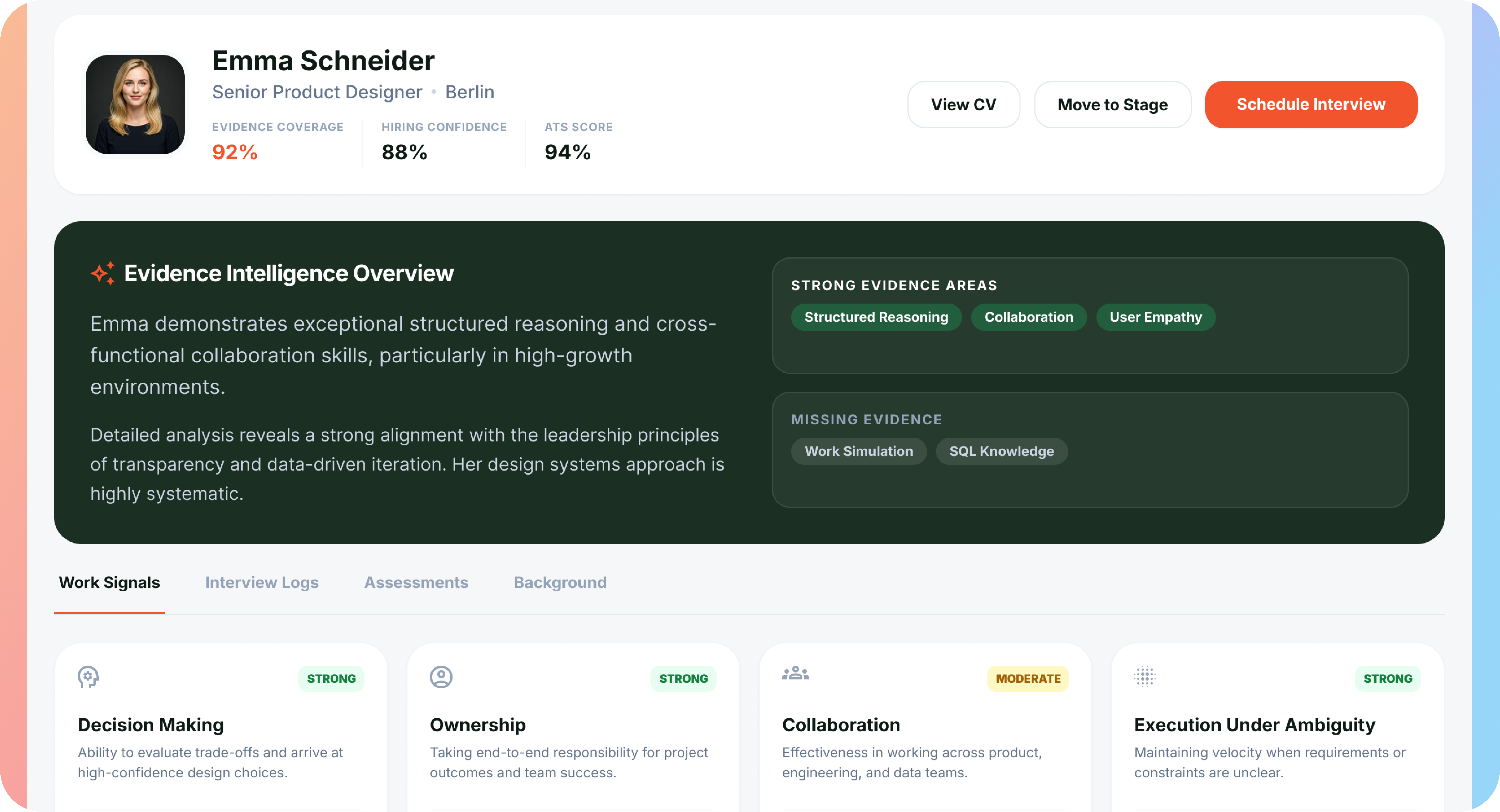
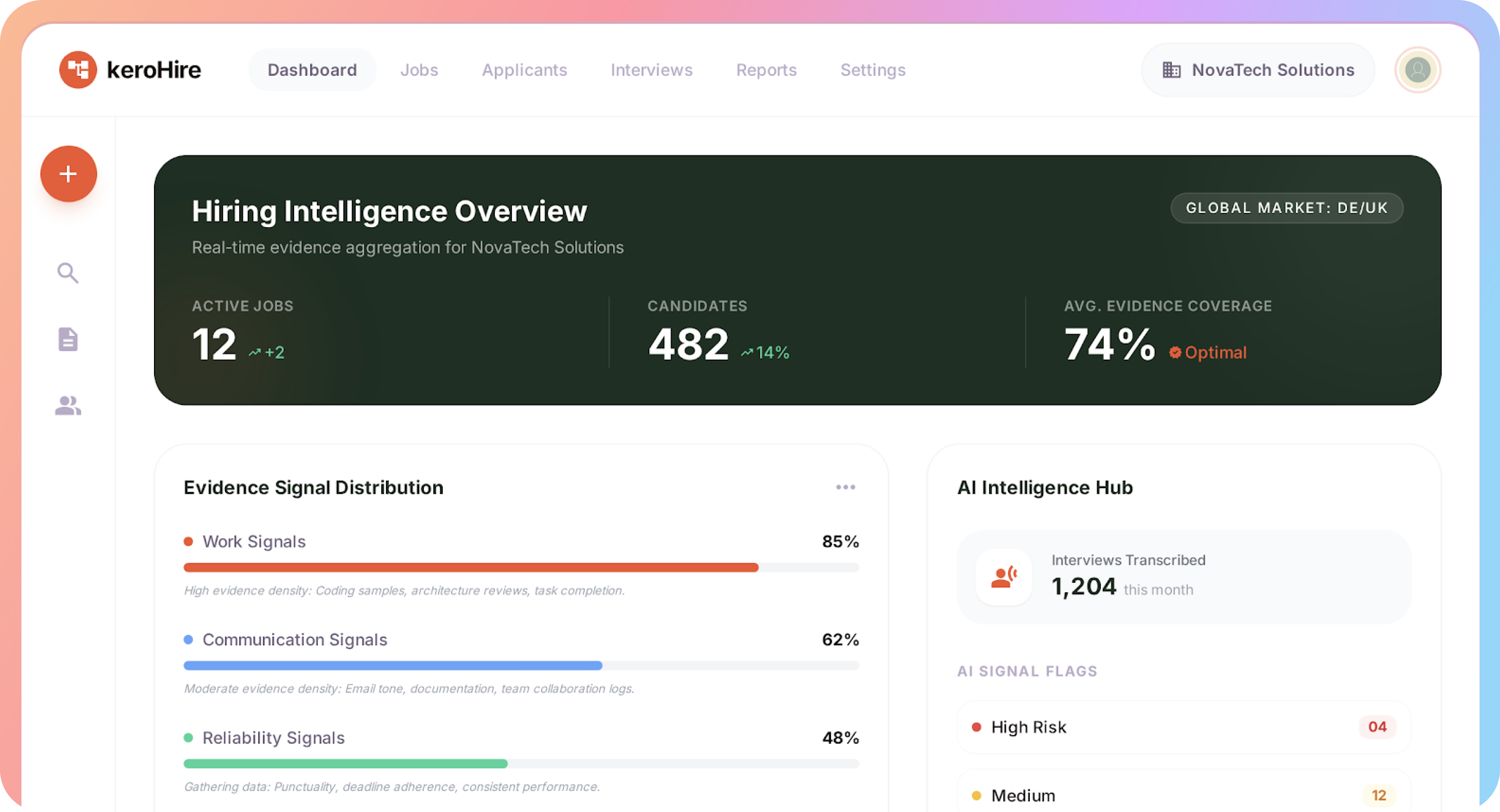
keroHire Evidence Intelligence Overview and Work Signals
Decision 02

Replacing psychometrics with evidence streams

Why

Static personality dashboards do not support defensible decisions. Hiring teams need Work Signals, Communication Signals, and Reliability Signals instead of trait scores.

Options explored

Personality dashboards · Trait + evidence hybrid · Three evidence layers only

Final solution

Introduced three dynamic evidence layers: Work Signals (role-based simulations), Communication Signals (interview + written reasoning), Reliability Signals (evidence gaps + trust indicators).

Impact

Clearer decision rationale. Better alignment with recruiter mental models. Reduced bias through structure.

Trade-off

More complex configuration for evidence map definition per role.

keroHire evidence streams and Work Signals
Decision 03

Turning ATS from workflow tool into decision system

Why

Traditional ATS platforms optimize for stage movement, not decision clarity. Recruiters needed evidence coverage and next actions on the pipeline.

Options explored

Classic pipeline board · Analytics overlay · Evidence-driven candidate cards

Final solution

Redesigned the pipeline so each candidate card communicates evidence coverage, signal strength, missing validation areas, and suggested next actions. Transformed the board into an intelligent decision support interface.

Impact

Faster time-to-decision. Clearer hiring conversations. Pipeline became active guidance, not passive tracking.

Trade-off

Required consistent evidence data at each stage to avoid empty states.

keroHire Evidence-Driven Pipeline Board
Decision 04

Introducing Interview Intelligence as a core layer

Why

Interviews were treated as unstructured conversations. Inconsistent evaluation and subjective bias resulted.

Options explored

Manual notes only · External transcription · Integrated transcribe, summarize, structure

Final solution

Integrated transcription, structured summaries, timestamped evidence quotes, and auto-generated scorecards aligned with the Evidence Map. Fully editable by hiring teams.

Impact

Improved consistency across interviewers. Reduced subjective bias. Better transparency and fairness.

Trade-off

Dependency on quality of transcription and summarization tools.

keroHire Interview Intelligence
Decision 05

Ethical approach to AI-assisted content

Why

With AI-generated applications, "AI detection" is often unreliable and ethically fraught. Recruiters still need signals without false certainty.

Options explored

No AI signals · Binary AI detection · Heuristic likelihood bands with disclaimers

Final solution

Rather than definitive judgments, the system uses heuristic likelihood bands (Low / Medium / High), transparent reasoning indicators, and clear disclaimers (not proof, only signals). Suggested follow-up actions.

Impact

Maintains trust. Addresses recruiter concern without overclaiming. Defensible and ethical.

Trade-off

Some recruiters may want a single "AI or not" answer; product resists that oversimplification.

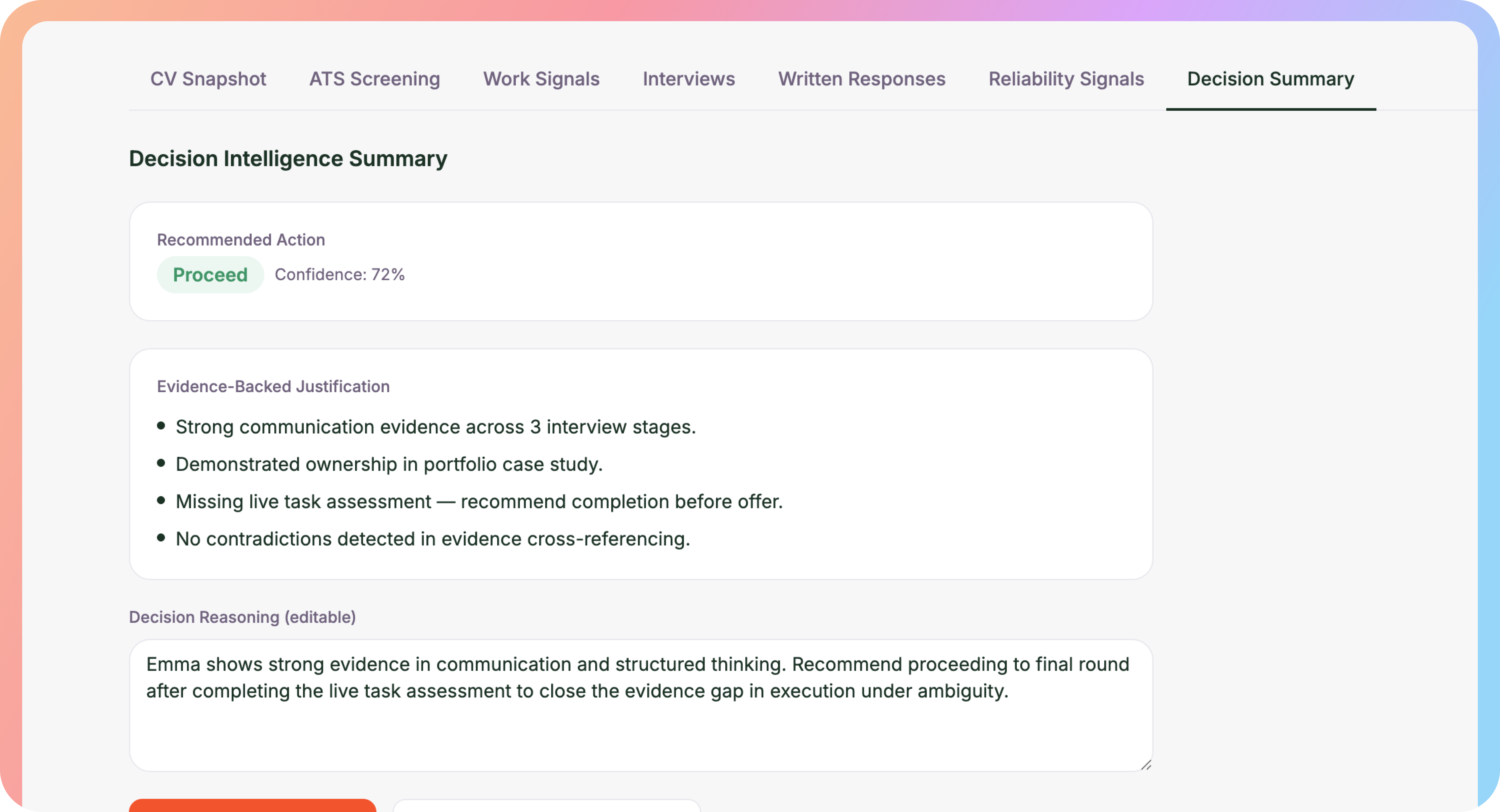
keroHire Decision Intelligence Summary

Validation

Aligning with real recruiter mental models

  • Core interaction patterns based on how recruiters evaluate: compare profiles, look for proof, identify risks before final decisions.
  • Candidate Report Hub structured into tabbed evidence sections mirroring real hiring discussions.
  • Prioritized insight hierarchy (Evidence → Signals → Summary), progressive disclosure, structured narrative summaries to reduce cognitive load.

Outcome

  • More consistent hiring decisions
  • Reduced bias through structured evaluation
  • Stronger documentation for German hiring contexts
  • Future-proof system for AI-influenced applications
  • Higher recruiter confidence in final decisions
keroHire is not just an ATS redesign. It is a shift in hiring philosophy, from personality speculation to evidence-backed decision making. The system empowers humans with better, structured evidence.

Instead of automating hiring decisions, the system empowers humans with better, structured evidence.